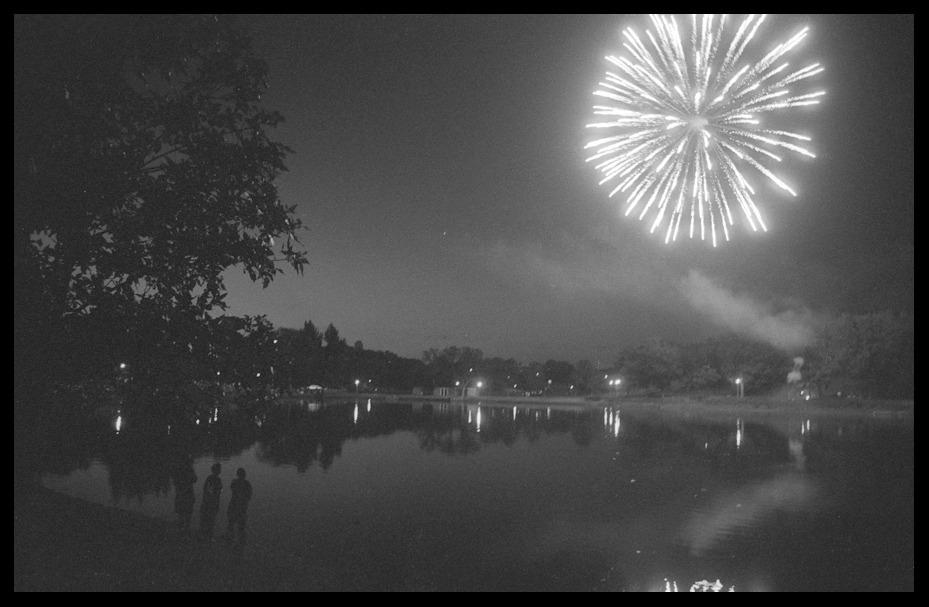
Lake Street USA (1997 - 2000) by Wing Young Huie
http://know.wingyounghuie.com/
Wing Young Huie's photograph, Fourth
of July, is a black and white photograph displaying the celebratory
ambience of a neighborhood on the Fourth of July. In the background, the clear
illumination of a fireworks display hovers above what appears to be the
houses of a neighborhood surrounding the lake. On the far side of the lake in
darker shade of gray, three people appear to be watching the fireworks from
afar. Upon closer examination, Huie appears to be emphasizing the implications
of diversity in America. By solely utilizing the black and white tones in
the image, Huie exemplifies the steep contrast between the culture of Caucasian
individuals and People of Color. Furthering this purpose, the separation of the
individuals silhouetted in black by the lake from the vibrant white explosion
of the fireworks represents the distinctive differences in perspectives on
United States nationalism between immigrants and natives. The separation of the
figures that may be wishfully looking at the firework and the celebratory
fireworks may be applied to Huie’s political views on the real life example of
immigrants crossing over the Mexican-American border.
Margaret Atwood and Wing Young Huie both present “othering”
as the distinctive segregation of a group of individuals based on their
ethnicity and/ or social class. In The
Handmaid’s Tale, Atwood presents “othering” through imagery of the unwomen
in the colonies. Atwood’s creation of mystery surrounding the presence of
unwomen in society via Offred’s language perpetuates the segregation of classes
within the society. The limited discussion of unwomen in the novel serves to
exemplify the concept of othering, in that there is knowledge of the “othered”
women, however the fact of their existence and conditions in society are
ignored. The imagery conveyed by the unwomen existing in some unknown location,
and the lack of desire to become “unwomen” as portrayed by Offred’s character,
uses pathos, and the association of fear to present the unwomen as an alien
group of women.
Wing Young Huie’s portrayal of “othering,” is similar to Atwood’s
in that both individuals use fear to isolate a population. In conjunction to as
how Atwood used verbal imagery to exemplify “othering,” Huie uses visual
contrasting imagery to exemplify imagery. In the previous analysis of Huie’s
photograph, Fourth of July, it was
discussed that the dark figures on the near side of the lake look enviously to
the far side of the lake where a celebration of Americans is portrayed by the
vibrant white of the fireworks. The lake
serves the same purpose as the limited conversation of unwomen does in Atwood’s
novel. The lake represents mystery, segregation and fear. It represents mystery
in that it is a passageway to the unknown of American culture on the far side
of the lake. It represents segregation in that it is a physical barrier to two
sets of people, the outsiders and the high class of society. Lastly, if the
image is to be taken in context of immigration policy in the United States, it exemplifies
the “othering” of immigrants in our nation. The lake represents fear in that immigrants,
the dark figures, are timid to cross “the border” and assimilate to American
culture. However, it more likely represents the more prevalent reluctance to
allow immigrants in the United States, and the fear that immigrants will
diminish the American culture.
Overall, Atwood and Huie portray “othering” as the
separation of individuals of different backgrounds due to fear and the lack of knowledge.
Their representation of the concept through imagery is effective in that it
isolates a population in society and attaches negative connotations to the
individuals of that population.
Word Count: 600

Gillian-
ReplyDeleteGreat first post; I enjoyed reading this.
Watch out for assumptions/generalizations- is this truly a comment on race? If so, how do you know?